Sunday, July 7, 2024

"A Quiet Place: Day One"

  ☆☆☆ 


Between the release of A Quiet Place in 2018 and A Quiet Place 2 in 2021, something odd happened: The world almost ended.

Is that hyperbole? Think back exactly four years, when we were inundated with images of death and violence, when we couldn't conceive of a future that hadn't changed in incalculable ways. Now we're in that future, and maybe it hasn't changed all that much, but we have.

That creates an interesting sort of problem for movies about the apocalypse. When we've seen what the world looks like when it's at the brink, it's hard to let go of disbelief, and in a movie like A Quiet Place: Day One that's even more critical than the movies that have come before.

Where, for instance, are the naysayers? Even when faced with certain annihilation, what we know now is that there would be a faction or two hundred that insists the whole thing is a government conspiracy. When told to literally be quiet, there are an awful lot of people who would insist they have every right to be noisy.

On the subject of noise, A Quiet Place: Day One opens with a title card that lets us know that New York City constantly emits sounds that are as loud as a human scream. What we know from the previous Quiet Place films is that the alien invaders are intolerant of loud sounds. Which begs the question: Why would they choose New York? Couldn't they hear the high-pitched squeal of subway brakes? Wouldn't that kill them all upon landing?

Alas, A Quiet Place: Day One offers 90 minutes to ponder such questions even while it delivers a story that is reasonably tense and astonishingly well acted by its three central performers: Lupita Nyong'o, as a poet dying of cancer who ends up fighting for her life in a different way; Joseph Quinn as a law student with a remarkably resilient wash-and-wear suit and tie; and Schnitzel and Nico, who play a cat named Frodo who steals every scene in which he appears (which is most of them).

The movie offers a motivation beyond the obvious for Nyong'o's character, Sam, to try to make her way north out of midtown. It seems like a flimsy sort of excuse to flirt with extreme danger and almost certain death, and when she's joined by Quinn's Eric the willingness of the two to make the journey is yet another one of those head-scratching moments. And yet, it ends up offering a strong and effective catharsis, and a rarity in a horror film: a scene of touching, tender humanity. That scene between the three main characters makes most of the rest of the experience worth it—but can't negate how strange the whole experience is.

Since this is a prequel, we already know most of the outcome, we know what becomes of the monsters, so we're left asking endless questions based on all the information we already have. I couldn't help but wonder about all the plot holes, all the rules of how the monsters behave that are seemingly violated in A Quiet Place: Day One. But then the movie came back to Nyong'o, Quinn and the cat—especially the cat— and that turns out to be, just barely, enough.

The apocalypse won't look like this, but hopefully the cats will cooperate.


Viewed July 4, 2024 — AMC Universal 16

1610

Tuesday, June 25, 2024

"Thelma"

 ☆☆☆☆ 


Pay attention in the opening scenes of Thelma, and see if you can spot the scam. You'll know it once it happens. You may even recognize it while it's happening. But the setup, the way the scammers hook 93-year-old Thelma Post into sending them $10,000 in cash, is convincing.

How do "old people" not realize they're being scammed? The same way you might fall for the big lie while you're watching Thelma. And that's sort of the point: Yes, Thelma is old, yes she spouts funny malapropisms, and no, she doesn't entirely understand how a computer works.

Do you?

The phone call Thelma gets sets her off on a grand adventure. It's tempting to call it a minor adventure, but anyone who lives in L.A. will know that Thelma covers a lot of ground in her quest to get that money back from the bad guys who conned her into giving it to them.

Played by 94-year-old June Squibb, Thelma is the widowed grandmother to Danny (Fred Hechinger), a Gen Z slacker who makes Gen X slackers look like overachievers by comparison. He's the one who unwittingly gets the action of Thelma rolling, and though he doesn't have a clue how life works, he's a doting grandson who prefers her to his parents—including Thelma's hyper-attentive daughter (Parker Posey)—and will do anything he can to help her.

Except, here's the kicker, the real crux of Thelma: She doesn't want his help. She doesn't want anyone's help. And she's not just stubborn. She knows she's old, but after such a long life, doesn't she get to live what's left on her own terms? This struggle for independence is what drives Thelma and gives it deeper meaning than a simple granny-with-a-gun tale.

In addition to Danny, her friend Ben, played by the late Richard Roundtree in his final role, wants to help Thelma. She only wants his electric scooter. But pretty soon they're gallivanting around the San Fernando Valley together, doing their best to stay one step ahead of her family.

It's a delightfully silly and thoroughly absorbing romp, one that recalls the more character-driven goofy comedies of the 1970s and early 1980s like 9 to 5 and Melvin and Howard, all held together by Oscar-nominated June Squibb, now in her third decade of a late-in-life career (her first on-screen role came when she was 56, her first movie role when she was 61). She's droll and straightforward and no-nonsense, a real character in the best sense, a character who feels complete and complicated.

And she is. That's the best part about Thelma. Sure, the jazzy score that could have come from a 1970s caper is fun, and all the performances—especially Hechinger—are top-notch. But it's Thelma's humanity that drives this film, even through it's more preposterous action-driven sections. Toward the end of the movie comes a gentle, human-scaled little scene that takes place on a park bench as Thelma talks to her grandson. Their exchange does something entirely unexpected in a film that has, by and large, lived up to our expectations to that point—it knocks the wind out of you. When I saw Thelma, the packed theater fell completely silent except for some uncontrollable crying jags.

Which isn't to say Thelma is sad or depressing or troubling. It's none of those things—well, maybe a couple of those things, though tangentially. The reason for the emotional response was ... no, on second thought, you'll need to see it yourself to find out. If you do, you'll discover that Thelma is big-hearted, effortlessly entertaining, and, in the best ways, as much a surprise as the woman herself. 


Viewed June 23, 2024 — AMC Burbank 16

1340

Sunday, June 16, 2024

"Tuesday"

  ☆☆☆½ 


Too many movies barely have enough ideas to sustain a scene, much less a full-length feature film, so it seems a little unfair to fault Tuesday for cramming too much into its 111 minutes.

There is so much that works so well in this film, a true flight of fancy that manages the impressive feat of grafting a magical fantasy onto a grounded story of death, grief and denial. In an unexpected dramatic turn (not her first, though you'd never know that from the marketing, though her first that's this aggressively downbeat), Julia Louis-Dreyfus gets a lot of credit for helping the audience navigate some tough transitions between human drama and increasingly surreal fantasy.

She plays Zora, the mother of a terminally ill 15-year-old named Tuesday, who is played perfectly by Lola Petticrew, a performer nearly twice the age of the character. Lola knows she will die of her unnamed disease, and Zora is in utter denial—not just of her daughter's mortality, but of the ways it has forced her to change her life as a single mother in London.

Lola is certain of her impending death because she's been told to expect it by none other than Death itself, in the form of a filth-covered macaw who can shrink to the size of a pea or grow to the height of a giant, and whose eternal job it is to appear to the doomed and cause their demise. The macaw speaks in a gruff, low voice, which is memorably provided by Arinzé Kent.

But Zora is not about to allow Death to take Tuesday, and when the bird presents itself to her and says, "Madame, you need to say goodbye to your daughter," Zora makes a dramatic and violent decision. What she does propels the rest of the film, and takes place against an odd and malevolent backdrop. Even as Tuesday and Zora grapple with the mother's decision, the world they live in seems headed for an apocalypse.

This long middle stretch is where Tuesday tries so hard, and so admirably, to show us the unexpected. It's a shame to say that not everything it tries works, that some of its oddities come across as truly puzzling and often confusing, while others offer up metaphors that don't quite hit their marks.

Tuesday is the rare film that could have benefitted from more screen time, but for its valiant effort and for the astonishing vision of writer-director Diana O. Pusic, it deserves to be seen and even cherished. Not many films try this hard. Tuesday doesn't always fly, but when it does, it soars.


Viewed June 16, 2024 — Laemmle NoHo

1610

Thursday, June 13, 2024

"Hit Man"

  ☆☆☆☆ 


What strange, fractious times we live in, when everything—and, increasingly, it seems everything—can elicit angry arguments and defensive posturing. Take Richard Linklater's latest low-key film Hit Man, which to my mind is just about as enjoyable as movies get. Many disagree. Angrily, defensively, assertively and in no uncertain terms they make it clear: Hit Man is bad.

In fact, Hit Man is very good, though it's got a quirky, oddball approach that fits Linklater's sensibilities, and doesn't care too much if audiences don't vibe with it. Moviegoers of a certain age know that even Linklater's exquisite Before films have met with head-scratching claims of boredom and smug elitism.

Not coincidentally to all this vehement debate about Hit Man is that this laid-back neo-noir comedy, which owes more than a little debt of gratitude and style to Robert Altman's The Long Goodbye (a movie that had its own vocal detractors in its day), is that Linklater's film debuted on Netflix with a minor theatrical release. Almost everyone who has seen the film has seen it at home.

I was fortunate enough to see it on the big screen, and Hit Man is a movie that benefits enormously from the theatrical experience. I'm beginning to think that's the crux of the problem, rather than the film itself. In a movie theater, there are essentially three choices: fall asleep (or do something else distracting, maybe involving the person you came with), leave, or watch the movie. Generally, people don't choose the first two options, though there's an exception for everything.

When you sit down and watch Hit Man unspool (or its digital equivalent) in front of you, it takes a little while to get into the film's funny little rhythms, though Glen Powell is immediately appealing as Gary Johnson, an unassuming college professor with the oddest of side gigs: He builds surveillance technology that helps the New Orleans Police Department in sting operations to capture would-be assassins. He goes along on these jobs, and ...

Well, what happens next in Hit Man is the fun. The movie plays best if you don't know anything else.

It plays worst, apparently, at home on Netflix. That's no surprise. If you have, roughly, three options at the movie theater, you have substantially more at home. You can make dinner or talk with friends or check your phone or look up the movie's stars on the Internet or get a pizza delivered or get high or get drunk or cut your toenails or feed the dog or anything else you want that you cannot do in a movie theater, where your attention is focused on the screen. At home, your attention is often focused almost anywhere but the screen.

Hit Man needs attention. It needs thought. Its jokes, which are many, sometimes take a minute to hit. And when its plot finally gets cranking, the movie assumes you have been paying attention all along. The minute Madison Figueroa Masters (Adria Arjona) walks onto the screen and tells her sordid, sad story, you'd better be listening and watching and keeping track.

Hit Man turns from low-key comedy and quirky slapstick into a captivating neo-noir that has all the classic elements, including some unexpected turns and some dark morality.

"I turned it off after 15 minutes because nothing happened." "A weak plot." "Awkwardly stitched together." Yes, Hit Man will seem to have all those flaws if you watch it at home while you're doing other things, or while you're wondering if there might be something different to watch. There's always something different to watch. The temptation to pause, mute or go back to the home screen is strong—especially for a movie like this, that depends on your commitment, that feels more like a character-driven melodrama from the Eighties, something like The Verdict or Absence of Malice that assumes its viewers are not distracted and inattentive.

Back to the film: It's a delight. It rewards patience, and cares enough to have a thematic perspective, even when its relative morality begins to feel questionable—which is part of its beauty. When a film is carefully enough made to make us question the decisions its characters make, that's a film worth watching. And Hit Man is very much worth watching.


Viewed June 12, 2024 — Egyptian Theater

1930

Monday, June 3, 2024

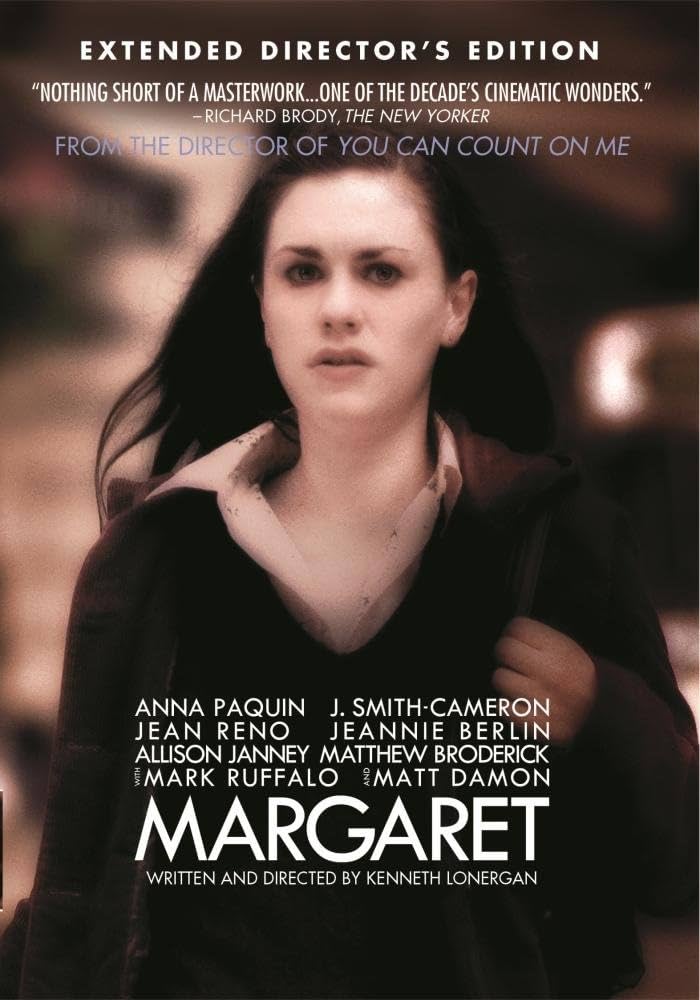
"Margaret" (2011)

  ☆☆☆☆½ 


In 1999, Paul Thomas Anderson's mesmerizing, confounding, challenging, beautiful, depressing, confounding, polarizing film Magnolia caught the uncertain mood most of the world seemed to be in leading up to the new millennium. That long film might well be called "operatic" both for its grand themes and the way it stops the action every now and then to allow its leading actors a moment to show off their skills, much in the way an aria stops the action of an opera just so we can marvel at talent.

Kenneth Lonergan's Margaret was originally shot six years later, but due to the kind of legal and artistic wrangling that seemingly can only happen in Hollywood, it was finished in 2011. Note that I didn't say "released in 2011," because Margaret was largely never released. For years, Lonergan had been trying to get his film to 150 minutes to satisfy his contractual obligations, finally settled on a 160-minute version, but when he did the studio largely abandoned it, and never giving the film a mainstream theatrical release. Meanwhile, Lonergan continued working on Margaret, and ultimately created a 186-minute "extended director's edition." While available on DVD, Blu-ray and streaming, this version has rarely been seen in theaters.

As part of its annual "Bleak Week" series, the American Cinematheque screened the 186-minute cut of Margaret at the Egyptian theater to a sold-out house. Having at last seen it, the rationale behind the studio's decision not to release Margaret is more discouraging than ever: They denied moviegoers an opportunity to experience an exquisite film, a movie that stands alongside Magnolia as an emotional epic that explores the convoluted inner workings of people just as the world was shifting.

Margaret hits even harder than Magnolia — not an easy task — because it was shot and originally intended to be released just five years after terrorists destroyed the World Trade Center. They did more than destroy buildings; they destroyed a nation's psyche, they made Americans, and New Yorkers in particular, painfully aware of the fragility of life and the ways it's impossible ever to really know what is going to happen next. The next 30 minutes could hold anything, a reality Margaret knows all too well.

Lonergan's script for Margaret contains no characters named "Margaret." The film is named after the poem "Spring and Fall," by Gerard Manley Hopkins, which begins:

Margaret are you grieving
Over Goldengrove unleaving?

The poem is written as an adult asking a troubled child if the simple act of leaves falling in autumn has left her forlorn, and sad about the state of the world.

Lisa Cohen is this film's Margaret. She is played by Anna Paquin in a performance that should have been nominated for every possible award. Paquin is revelatory as a girl who we meet when she is confident and teasing, flirtatious and intelligent, happy and eager and bright. By the end of the movie, she will still be some of those things, but she will not be many of them. In the sort of incident that could happen anywhere at any time, Margaret is involved (just how, it's best not to know) in a bus accident that kills a woman named Monica. She is played by Allison Janney, who has only one scene in the movie — but it's a scene that must stay with us for the entire duration of this long, complicated film. It does. You've seen heartbreaking moments in movies, but if you haven't seen Margaret, you've never seen the definitive one.

The accident is a devastating, life-changing moment for Lisa, but not always in the most obvious ways. As the film progresses, Lisa has a fraught relationships with her actress mother (J. Smith-Cameron), a math teacher (Matt Damon), a boy who likes her (John Gallagher Jr.), a boy who doesn't really care about her (Kieran Culkin), and a woman (Jeannie Berlin) who was close friends with Monica.

Relaying the rest of the story would be pointless—there is too much of it. One of the many wonderful imperfections of Margaret is how much story it wants to pack into its running time. The extended director's cut runs more than three hours but plays like a movie half that length. Paquin is at the center of it all, carrying the film with such effortless confidence that we sometimes forget we're watching a piece of fiction; Lonergan, who loves working in a naturalistic style, has created a film that's often packed to the edges. It demands and earns our attention, even in some very strange and problematic moments when Lonergan decides to play a piece of music too loudly or adds in voices that seem to be coming from another scene.

These directorial flourishes make Margaret distinctive, but what makes it special and unlike any American movie I can remember seeing is the way the audience never knows from one scene to the next how a character might respond. Scenes change on a dime in this film, and what begins as a happy and carefree moment might end a few minutes later with lacerating anger. In that, Lonergan understands the way most people actually communicate with each other—poorly, haltingly, unpredictably. Watching Margaret is a stark reminder of how little we can ever know anyone else, their motives, or their fears.

This is a glowing film. It knows how terribly we have been hurt — not just by September 11, not just by technology and communication (it was filmed before smart phones but released after they became ubiquitous, which makes for an interesting commentary), not just by each other. Rather, we've been hurt by existence. Like Margaret in the poem, we have seen the world dying; confidence that it will return again does us no good. We are grieving for what we have lost, right now.

In its final moments, as if it hadn't already been clear through its frequent use of classical music, Margaret shows us what it means to be: an opera, maybe a tragedy, maybe a comedy, maybe a little bit of both — I was surprised by how funny the film is, despite being shown at "Bleak Week." In any event, it is bigger than life. It takes a seemingly everyday kind of tragedy and infuses it with wild, raw emotion. Watching Margaret, you'll careen from laughter to shock, from outrage to tearful emotion, sometimes within moments. Lonergan does not shy away from the hard stuff here, but Margaret is never angry or depressing.

By the end of this fascinating and emotionally draining (but not bleak) film, it is very much "Margaret" you grieve for — the girl who can never be innocent again, and the world that can never be innocent again. But still both will revive themselves. They will remake themselves. They will grow again. One way or another.

Viewed June 2, 2024 — Egyptian Theater

1900

Saturday, May 25, 2024

"Challengers"

 ☆☆☆☆ 

The poster for Challengers wants you to believe that the star of the movie is Zendaya, the mononymous performer who two years ago was named by Time magazine as one of the most influential people in the world. She sits at the center of Challengers, the absorbing, hyperactive new film by Luca Guadagnino, who made the absorbing, languid Call Me By Your Name in 2017.

"Her Game. Her Rules," one of the posters for Challengers says, making it clear beyond all doubt that this is not in any way a gay movie. And yet, Challengers often feels more boldly gay than even Guadagnino's earlier, dreamily homoerotic movie. Yes, Zendaya's Tashi Duncan sits at the center of a love triangle; yes, she uses her physical appearance to flirt with and ultimately bed two men; and, yes, they are each vying for her attention ... well, ostensibly.

That's when Challengers gets really interesting, not exclusively from a gay point of view, though largely. Here is a film that does not shy from acknowledging the far-reaching sexual interests of its main characters, and that does much, much more than suggest that the two men (Mike Faist, the fair-haired; Josh O'Connor, the dark) who are enamored of Tashi are equally smitten with each other. Maybe more.

The place Challengers starts seems to be simple: Tashi watches these two men in a tennis match. Almost instantly, we're pushed back two weeks, and then another 13 years, to the night these characters all first encountered each other. The screenplay by Justin Kuritzkes volleys back and forth in time like a tennis ball, daring us to keep up with it. (At one critical point, I finally broke down and had to admit I wasn't quite sure when was happening up on screen, though it also no longer seemed to matter.)

Faist's Art Donaldson and O'Connor's Patrick Zweig are best friends. They share everything with each other. They may, the movie implies, have shared even more. But one thing is clear: Each is smitten by the other, and never once does Challengers suggest they shouldn't be. When they meet Tashi, the race to bed her seems more a desire to impress each other.

As they jockey for position, Challengers kept bringing to mind the odd, repressed sexual games that characters in Hitchcock movies played, and it it's worth noting that the only characters we see kiss each other with intensity or get naked around each other are the two men. The story progresses, moving back and forth in time as first Tashi seems on the cusp of stardom, then Patrick and, finally, Art. Each is trying to outdo the other. Life for them is a competition. Winning is everything—but not winning the game, rather winning the approval, favor and love of the other.

Though there are more than a few moments in which Challengers is set in a world of luxury and glamour, neither it nor its characters are interested in material possessions—they want to possess and control each other. Despite its outwardly beautiful imagery (like all Guadagnino films, it's obsessed with sensual depictions of the world), Challengers is infinitely more interesting in exploring the emotional workings of people who know they are always playing a game.

The most fascinating part of the movie turns out to be that we're never quite sure exactly what game is being played. Just when we have it figured out, Challengers offers an ending that hits the ball right back into the place it began, with a deliciously ambiguous final shot that could mean just about anything.

The boldness of the game it's playing is really the point—it is irrelevant who wins, as long as everyone has a great time at the game. Challengers turns out not, despite her presence on the poster, to be about Zendaya and her rules, but about all three of these beautiful, manipulative people and the games they play with each other. Watching them is like watching a modern tennis match: You may get whiplash from turning your neck at the ball's impossible speeds, but you can't take your eye on the damn thing, anyway.


Viewed: May 25, 2024 — AMC Universal 16

1920

Sunday, May 5, 2024

"I Saw the TV Glow"

 ☆☆½ 


Maybe this is what a generation gap looks like? When I Saw the TV Glow ended and I left the theater, I heard a group of people next to me raving about their experience. "It was so creepy!" one of them said. Giggling, another confirmed, "That was the most disturbing movie I've ever seen." Everyone marveling about what they had just witnessed was a teenager.

Whatever it was they saw in the movie, I missed it. There is nothing in this film that qualifies as "most disturbing," unless you haven't seen many movies. I'll give them "creepy," but "so creepy"? Not by a long shot. There are, apparently, also lots of coded references to the trans experience in the movie, or so I read once I got home, desperate to understand the significance of what I just watched. Even the most generous film writer acknowledges that these references must be gleaned, that they require a particular "reading" of the film. All right. I'll give it that. I guess I read it wrong.

While I Saw the TV Glow contains some interesting images and an intriguing setup, the movie moves forward at such a sluggish pace that the best way to describe the experience of watching it is being overcome with an unshakeable sense of ennui. Its characters seem to sleepwalk through the world, and even the things they claim are exciting don't seem to excite them much.

The most important of those is an imaginary TV series called "The Pink Opaque," whose name I guess qualifies as one of those coded references. In the mid-1990s, it plays late on Saturday nights on a TV channel called The Young Adult Network, which is too late for Owen (mostly played by Justice Smith) to watch it. An older girl named Maddy (Bridgette Lundy-Paine) invites him over to her house to secretly watch the show in the basement; to get there, he has to lie to his overprotective mother. That's another one of those references to the queer experience. Ultimately, Maddy records the show and hides videotapes for him to find. They both become obsessed with the show, which is a fan-driven fantasy series—a teen "X Files" crossed with "Buffy the Vampire Slayer."

Maddy disappears. Owen is left to wonder what happened, and to try to piece his life together after their shared obsession ends. Then, as suddenly as she vanished, Maddy returns, and tells Owen the story of what happened, and how her fandom has crossed all bounds of normalcy.

Mixed in to I Saw the TV Glow are clips from "The Pink Opaque," and seemingly real-life appearances by some of its strange monsters. The idea, I guess, is that Owen and Maddy have taken their love of the show to extreme levels. They can't distinguish what's on screen from reality. They descend further and further into a shared madness.

There's nothing wrong with the idea of I Saw the TV Glow, or even with its near-catatonic state. Writer-director Jane Schoenbrun has a real talent for creating a mood; whether that mood is one that makes for great storytelling is the question. Yet while I Saw the TV Glow creates a distinctive look, it's a pastiche. There's a lot of Donnie Darko, bits of Heavenly Creatures, touches of Poltergeist and even big swaths of Being There. Many of the ideas and a couple of key moments of body horror are deeply influenced by David Cronenberg, whose Videodrome preceded this film by 40 years. To those of us who aren't teenagers, it all feels like things we've seen done before, and better.

The curious inertness of I Saw the TV Glow extends to its characters. They are all able to talk about their feelings of alienation and otherness, but not define them. They lack any insight, or even curiosity about the world around them. It's not even TV that matters to them—it's that one TV show. Why? How? To what end? The movie doesn't much care. Just when it should be trying to explain its feelings, it heaves a sigh, rolls its eyes and says, "You'll never get me." Maybe that's true.

Coincidentally, I saw I Saw the TV Glow on May 4, which has become the manufactured "holiday" of "Star Wars Day," a day on which obsessive fans celebrate their obsession. Scrolling through social media, I read about grown-ups who are still angry with George Lucas for "changing" the film they loved, as if it has no right; I saw polls asking people what Star Wars characters they'd most like to invite to dinner; I read posts in which people contemplated minor plot points from these films with more zeal than they discuss the election or the geopolitical condition of the world or the climate crisis. Obsessions run deep. They're real. People construct their entire lives around fictional creations.

There is something fascinating about that. There's something that could make a captivating, entertaining and thought-provoking film. Unfortunately, queer-coded or not, I Saw the TV Glow isn't it. 


Viewed May 4, 2024 — AMC Burbank 6

1950