Thursday, October 26, 2023

"Leave the World Behind"

     ☆ 


A late-summer weekend getaway to Long Island becomes a nightmare of existentialist dread in the film adaptation of Leave the World Behind, a sometimes dazzling, sometimes frustrating film that largely eschews politics for tension, despite the presence of Barack and Michelle Obama as executive producers.

It's based on an equally dazzling, equally frustrating novel by Rumaan Alam, which by alarming coincidence was released during the height of the COVID pandemic, when even the most calm and rational of people couldn't help but be sucked in to conspiracy theories, ideological warfare, and often-justified paranoia. Three years removed from the darkest of those days, it's easy to forget just how hopeless, anxious and distraught the world felt, but no matter—Leave the World Behind is here to help those feelings zoom right back into the front of your mind.

Both the novel and the film are the story of a well-off White family from Brooklyn—mother, father, teenage son and daughter—who rent a lavish house on Long Island for a much-needed getaway. Just after they arrive, mysterious things begin to happen, not the least of which is a massive oil tanker running aground on a relaxing beach. Then comes a knock at the door in the middle of the night, heralding the arrival of a Black man who, accompanied by his daughter, claims to be the home's owner.

Initial tensions give way to a growing sense of uneasiness as the world seems to start collapsing around them, and part of the enjoyment of the film—if that's quite the right word, since it's disquieting and intense—comes from never quite knowing exactly what's going to happen next, or why, so there will be no major spoilers here.

The husband and wife, Clay and Amanda, are played by Ethan Hawke and Julia Roberts, who is given the thankless task of reciting some of the most stilted expository dialogue in recent memory during the film's awkward opening scenes. Leave the World Behind does not get off to a great start, though an endlessly roving, twisting, careening camera (courtesy of cinematography Tod Campbell and a laundry list of visual effects companies) helps to disorient viewers and serve notice that the film never intends to find a center of balance. It's a queasy movie, both because of that ever-moving camera and because of the uncertainty of the story.

Mahershala Ali plays G.H., the wealthy homeowner, who seems to be harboring a fair number of secrets when he shows up to the house with his daughter Ruth (Myha'la), but the screenplay by director Sam Esmail copies the same core problem of the book by introducing tensions of both race and class and then never following through. Incomprehensibly, the movie changes Ruth from G.H.'s wife to his daughter, undermining the tension between two married couples that permeates the often florid prose of the book.

Yet, as things get stranger and stranger, and the world goes off the rails as its consumed by some horrendous conflict, Leave the World Behind offers some top-notch filmmaking, including a central sequence that serves as its own master class in parallel cutting as each of the main characters discovers a small, puzzling, disquieting piece of the overall puzzle.

In tiny little snippets, the characters begin to work out some—but not even close to enough—of what's happening. All along, the movie stays sharply focused on the six people in the house, with only small and supremely uncomfortable moments in which they manage to encounter others. For the most part, though, these characters face the dawning realization that they are soon to be all they have.

By design, very little is given an explanation, though the filmmakers aren't quite as bold as the novelist, and in the end succumb to spelling out the backstory perhaps a bit too pointedly. If the film is largely designed to confuse, disorient and disturb its audience, it ultimately can't resist the temptation to provide concrete details about the central events. Still other key moments, like the sudden appearance of hundreds of deer or the delightfully weird moment in which self-driving cars pile up on the road, are allowed to remain mysterious, and they're better for it.

Leave the World Behind may feel too obtuse to some viewers, too languid for others, and maybe even too on-the-nose disturbing for a few. Stick with it, though (ideally in a movie theater; it plays on the big screen for a few weeks before its debut on a certain major streaming service), and it and its disturbing strangeness will probably stick with you.


Viewed October 25, 2023 — TCL Chinese Theater

1900

Sunday, October 22, 2023

"Killers of the Flower Moon"


David Grann's meticulous, riveting book Killers of the Flower Moon is not, in itself, an angry or vengeful piece of writing, but the feelings it evokes in a reader are ones of anger and vengeance. Reading it is a harrowing experience, one that opens the vein of the past to find the blood inside has been poisoned with racism, bigotry, intolerance and hate, all cloaked by the veil of the American flag. The story it tells is both largely unknown and genuinely unforgettable.

Now, Martin Scorsese has made a $200-million dramatic adaptation of Killers of the Flower Moon, and it is a grand and thudding disappointment, dramatically wrong-headed, apparently lacking in any self-awareness that the story it tells is not at all the story that matters.

The story told in the book is an epic, sweeping one, spanning many decades, beginning with the U.S.-sanctioned ethnic cleansing and forced diaspora of millions of native Americans, commonly called the "Trail of Tears," and leading to a series of shocking murders (and they truly are shocking), many of which involve family members of a woman named Molly Burkhart.

Molly and her family are Osage "Indians," native Americans who were herded to a rocky, ugly part of the Oklahoma prairie, where the American government figured they would lead hardscrabble lives, if they led any lives at all. Someone forgot to check the ground, because it turns out that Osage land was some of the richest in oil anywhere in the United States. Within years, the Osage people became the richest Americans, and some of the richest people anywhere in the world. Then they began to die.

Molly Burkhart's sister was one of the first recognized murders. Her story is one of pain and anguish, as Molly watches the destruction of her land, her home, her community, her people, her family, and ultimately her marriage and, almost, herself.

There's a key plot point in the book that normally would be considered a spoiler, if the film's trailer didn't give it away so clearly: the perpetrators of some of these horrific murders are Molly's seemingly loving husband and his uncle, a pillar of the community and supporter of Osage rights. Except he's not. He's doing it all for the money.

And this is what the movie version of Killers of the Flower Moon gets so wildly wrong: It turns a story about one person, one family, one community, and one people who are degraded and devalued and dehumanized every single day, and who fight so hard to have these murders solved, and turns it into a Martin Scorsese gangster melodrama.

The most brutally inhuman people in the story, William Hale (Robert De Niro) and Ernest Burkhart (Leonardo DiCaprio), Molly's husband, are made into its stars. A roster of white men cycle in and out of Killers of the Flower Moon, some of them dastardly villains, some noble heroes, and by and large this is their movie, this is their story. That it takes place on Osage land is mostly not germane to the story. Scorsese and screenwriter Eric Roth, both of whom should know better than this, let the movie become a story about white men ratting out other white men. About one white law enforcement officer going toe-to-toe with white crooks.

Throughout, once in a while we get to see more of Molly herself (Lily Gladstone), mostly as she suffers in incoherent pain while her husband administers poisoned insulin to try to kill her.

The purpose of all these deaths is "head rights," the legal process that ensures the relatives of a dead Osage who owned rights to oil and mining deposits, would automatically pass them to the next of kin. To make sure head rights went to the "right kind" of people (that is, Whites), greedy, unscrupulous White men started marrying Osage women, then systematically poisoning them or arranging their deaths in myriad ways. They'd even kill the children, too, if that's what it took.

Grann's book details all this in astonishing clarity. Scorsese can never quite latch o to the story, because to do so requires the entire movie be told from the perspective of the Osage, particularly the Osage women, particularly one Osage woman—Molly Burkhart. That's not what the movie wants to give us.

I've rarely seen a movie so utterly unable to hone in on its story. Even at 3 hours, 26 minutes, Killers of the Flower Moon seems to have left too much on the cutting-room floor. Relationships aren't clear, consequences aren't clear, motives aren't clear. You can watch the film and get a good idea of what's happening, but it takes a little bit of effort.

The true story of what happened to the Osage—not just to the Burkhart family, not just to this small community, but to thousands, maybe even more, of Osage over the years—deserves to be told. Alas, Killers of the Flower Moon hasn't nailed it, despite the glowing, magnificent performance of Lily Gladstone as Molly, who should be the biggest star in the movie, but is third billed.

Killers of the Flower Moon isn't a bad movie. Elements of it are remarkable, particularly a jaw-dropping set design. Gladstone commands the screen every time she's on it, though De Niro still mugs too much, and Di Caprio seems slightly out of his depth here in a nuanced, complicated role. He's put in the unenviable position of having the audience knowing his terrible deeds, even as they watch him coming home and making love to Molly. He is the bad guy, but the movie wants to position him as the romantic lead. Hitchcock might have been able to get away with that; Scorsese and screenwriter Eric Roth are incapable. Grann conceals the truth about the nature of these men until midway through, but the film sets them up as the bad guys—Scorsese's beloved gangsters—from their first scene.

For a director whose first mainstream success was the female-focused Alice Doesn't Live Here Anymore, it's confounding that he struggles to put Molly—not Ernest and Hale—at the center of this story. Sure, DiCaprio is the bigger star, but Gladstone displays her character's soul, one wracked by terrible feelings of hatred, death, and loss. By all rights, she's the star of the film and Molly should be the star of the story (in this streamlined version, at least), and Killers of the Flower Moon would have been infinitely better if it had let her be exactly that.

As a finale, the movie has a group of elite white radio actors tell the rest of the story, segueing to a group of nameless, faceless Osage performing a ceremonial dance, Killers of the Flower Moon highlights exactly what it gets so disastrously wrong: showing the White people in close up, giving them names and personalities, while dismissing the Osage as anonymous pawns.

It's enough to get admirers of the book angry all over again.


Viewed Friday, Oct. 21 — AMC Universal 12

1745

Monday, October 2, 2023

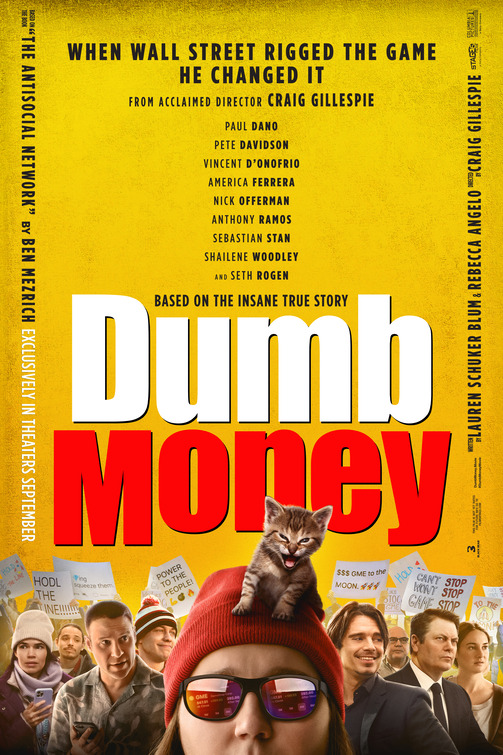
"Dumb Money"


Not all that long ago—just four years ago, by the calendar, or last year, if you don't count the two missing years of the pandemic—movies like Dumb Money were Hollywood's bread and butter: Cheap, easy, fun entertainment that could reasonably be expected to bring in an audience of adults looking for an absorbing diversion. The movies were full of Dumb Money.

Not so much anymore. Dumb Money is still a good movie. Maybe even slightly better than good, though not quite good enough to be great. It's got an incredible cast, all of whom deliver amusing, credible performances, and it's got some worthwhile observations about one of the weirder bits of recent history.

If you don't pay very much attention to the stock market, there's a good chance you missed the story that Dumb Money retells: How, in early 2021, when the world had tired of the pandemic and lots of people were still white-hot with anger over the ugly, tumultuous summer of the year before, a whole bunch of otherwise normal people got together and turned the tables on Wall Street. They did this by taking two stock that were considered such terrible businesses—GameStop and AMC Theatres—that big investors had actually bet against them. And like the spoiler who comes in, bets against the table in craps, and wins, they turned the game around.

There are a lot of really interesting, disturbing, uncomfortable things the GameStop fiasco revealed about Wall Street, the herd mentality of the Internet, the willingness of people to follow leaders they don't even know, the 21st century obsession with wealth. Dumb Money only bothers to look deeply at the first of these, because it views the people who caused the financial headache to be heroes. And maybe they are. Based on Dumb Money, there's really no way of knowing, because the script isn't very deep.

But it is fun. It's always fun to watch people stick it to The Man. It's always fun to see people beat the system. Fun With Dick and Jane is nearly 50 years old, but it's still a hoot—and it wasn't even a true story. This movie is about on par with that one, though I don't think it will take 50 years before people forget about it entirely.

It's fun to watch, it's inoffensive (unless you're easily offended by crude language), and it's well acted by a lot of excellent performers. It's also, curiously, a bit of a time capsule, as it takes place at a time when everyone was still wearing face masks, a moment this movie commemorates. And yet, Hollywood has killed this kind of movie, at least theatrically. Movies like Dumb Money exist now almost entirely to be tossed into the great Content Machine of streaming services. And that, despite Dumb Money's borderline mediocrity, is a shame. Had I watched this on streaming, I probably would have turned it off; it's simultaneously lightweight and convoluted, and attention spans being what they are, who wants that anymore? But in a theater, where the options are watch the movie or leave (or, sadly, and increasingly, turn on your phone and stare at it), Dumb Money effectively captures the attention, tells a good story, and in its own tiny way, reminds us what moviegoing is all about.

Or, used to be.


Viewed October 1, 2023 — AMC Topanga

1635

Tuesday, September 19, 2023

"A Haunting in Venice"


There have been some pretty good Agatha Christie film adaptations over the years, and some pretty bad ones, and some truly awful ones (word to the wise: avoid 1985's Ordeal By Innocence at all costs), and Kenneth Branagh has made films that fall into both of the latter camps. Overwhelmed by unnecessary CGI, filled with performances that border on camp, and unhelped by overripe camera work, Branagh's first two Christie efforts were not good films.

The third time's sort of the charm, then, as Branagh returns as both director and star of A Haunting in Venice, which is an intriguing riff on one of Christie's lesser-known novels ("Hallowe'en Party") that is neither particularly faithful to or precious about the source work. It's mostly an entertaining diversion, but it sure does move like a lead brick sometimes.

Its terrible pacing is not helped by dark and murky photography, which would be appropriately moody if it weren't combined with directorial choices that mistake slow for atmospheric. As an Agatha Christie drawing-room mystery, A Haunting in Venice is filled with dialogue, narration and lots and lots and lots of flashbacks to things we can't possibly have known ... which usually are part of the fun, but this time bog the whole thing down with a dismal, glum air.

So, why in the world am I recommending A Haunting in Venice? Mostly because it's fun to see a labyrinthine mystery play out on screen, fun to see strong performers like Michelle Yeoh and Tina Fey chew up the scenery with necessary overacting, and fun to see such sumptuous production and costume design ... when you can make anything out. The whole affair is murky, both in plot and in physical appearance, but in the end as Branagh's Hercule Poirot susses out the shenanigans—this time involving one suspicious death, one outright murder, and a whole host of other nefarious deeds, all on Halloween Eve in the heart of Venice—it's one of moviegoing's core delights to see a good, old-fashioned murder mystery with a clever, I thought so! kind of conclusion.

Watching A Haunting in Venice takes some effort, but it's worth the extra work.


Viewed Sept. 17, 2023 — AMC Burbank 6

1415

Sunday, September 3, 2023

"Oppenheimer"

     ½ 


The first time I saw Oppenheimer, in 70mm at a spectacular old movie palace, something was off. It might well have been me, but I came away feeling overwhelmed by Christopher Nolan's film—not in that sense of being overwhelmed by something spectacular and new, but overwhelmed as if I had been beaten into submission for three hours by a relentless, pounding score and rapid-fire editing that left me dizzy.

Now I wonder if part of my problem—which led me to not reviewing the film at the time, sensing I was missing something—was how I saw Oppenheimer. I'll never say no to seeing a movie projected on 70mm film, but that more standard cinematic version of Nolan's film felt claustrophobic and close-up. Now I understand why.

I've seen the film again in its "native" format of 70mm IMAX, and it's an entirely different experience. The story is still often confusing, the film still feels overlong and sometimes preposterously talky, and the non-stop score is still hypnotically distracting. Yet, opened up for the IMAX screen, particularly when Nolan has chosen to use the entire IMAX screen, that felt muddled and tight now feels free and at least mostly coherent.

Oppenheimer still bears all the hallmarks of being a Christopher Nolan film, and I'm beginning to realize a cinematic truth that Nolan and I aren't really on the same wavelength. He's so enamored by the mechanics of filmmaking that simple things like narrative cohesion aren't entirely important to him. At least in Oppenheimer the dialogue is almost always clear (something that's not often true in Nolan movies), and the story's non-linear structure works because if shorn of it, Oppenheimer might be tediously dull.

Most of the film is structured around three dialogue-heavy meetings: One in which J. Robert Oppenheimer (Cillian Murphy) has his security clearance revoked; one in which Oppenheimer, Lewis Strauss (Robert Downey Jr.) and other physicists meet to discuss the ramifications of nuclear arms; and a Senate hearing to confirm Strauss for a presidential cabinet post. It's hardly the stuff of mesmerizing drama, so Nolan mixes it all up with a more straightforward narrative of Oppenheimer's development of the team that created the first atomic bomb.

As in so many Nolan movies, the key to Oppenheimer is keeping up with the narrative time shifts, and this becomes slightly easier in the IMAX version, as Nolan uses both aspect ratio and black-and-white film to indicate different periods. There are double-crosses and triple-crosses and tales of espionage, and of course there's the development of the bomb itself, and the spectacular scenes involving the first Trinity tests. The history is portrayed by what we used to call an "all-star cast," an impressive roster of talent, some of whom get more screen time than others, and a few of whom feel terribly wasted, underserved by a screenplay that might have spent more time getting the words, thoughts and feelings as sharp as the visuals.

It all adds up to a film that is both more and less engrossing than it might have been if told more traditionally. Nolan's storytelling techniques make Oppenheimer a bit of a muddle sometimes—though its more confusing moments somehow seemed slightly more coherent on the massive IMAX screen—while his filmmaking techniques make the film an experience to be savored on the giant screen. IMAX really is the optimal way to see the film; Nolan's use of the format isn't a gimmick, even if it's unfortunately not easy to see the film in the combination 70mm film and IMAX he intended. If you're near one of the 30 movie theaters (in the U.S.) where that's possible, Oppenheimer is truly an event. If you're not, you may walk away wondering what all the fuss is about. 


Viewed July 25, 2023 (70mm) — Regency Village; and September 3, 2023 (70mm IMAX) — AMC Universal 16

1945 / 1625

Thursday, August 31, 2023

"Barbie"

    ½ 


Being this late to the cultural watershed moment of Barbie is an interesting experience: I've heard everyone raving, I've read both the reviews, criticisms, analyses and musings. And, finally, I've at long last seen the movie itself. I really liked it. Barbie is, for the most part, an undeniably good film. When it's bad, like in the long stretches with a supremely unfunny Will Ferrell, it's still amusing. There is hardly anything negative to say about Barbie.

That in itself is a more than spectacular achievement on behalf of director Greta Gerwig and the script she wrote with Noah Baumbach. It's a huge credit to Margot Robbie and Ryan Gosling and Rhea Pearlman and America Ferrara and Kate McKinnon and every one of the other performers, almost all of whom are just wonderful. ("Almost" because of the movie's big, unavoidable Will Ferrell problem.)

When Barbie reaches its emotional climax, not only is it shocking that a movie about a toy has an emotion climax (but, really, after all those Toy Story movies, should it be shocking?), but that the film has so successfully and confidently navigated its path from absurdist, satirical comedy to sensitive emotional drama that, in an age of mindless superhero, horror and "franchise" fluff, Barbie at its core is just a really, really good, satisfying, enjoyable, less-than-two-hour-long movie.

The overwhelming box-office success of the film might, if nothing else, force some serious self-reflection from today's crop of writers. As they carry their picket signs, they might also consider how amazingly well Barbie illustrates that a complete character arc, a wonderfully satisfying screen-based entertainment, does not need to play itself out over 3½ or 10 or 26 hours. Two will do just fine.

The core story of Barbie's quest for self-discovery, her mythical journey into the "real world" from her home in Barbieland, and the effects it has not just on her self-determination but that of her self-proclaimed "boyfriend" Ken, is engaging and wonderful. Except for Will Ferrell's big, gaping wound of non-comedy, it's all splendid.

Which gets me to the crux of this. In improv parlance, not the but... as much as the and ...

Because Barbie is using its anti-consumerist story to supremely consumerist ends. The movie seems to poke fun at Barbie manufacturer Mattel—yet every joke in it was approved by and presumably encouraged by Mattel itself with the idea that being hip and cool and "meta" could ultimately help it sell more Barbie dolls. It is impossible to watch Barbie and not be constantly aware of its smug, look-at-me corporate antics. The "subversion" helps it sell dolls in the 21st century.

It is, ultimately, a two-hour commercial.

Do I hold that against Barbie? I don't think so. It's still a very, very good, sensationally entertaining film. It does bear the imprimatur of an important, exciting filmmaking talent. And it's also a corporate marketing gimmick. It exists to revive a moribund toy franchise.

The story of Barbie is both light and airy and silly, and also deeply thoughtful and not a little cynical. And so is the very existence of Barbie itself. If nothing else, Barbie is living proof of the paradoxes it seeks to show are endemic in the world: It is possible to adore Barbie and be deeply suspicious of it all the same. It is possible to know Barbie is, above all, a hugely successful marketing initiative, but also one fine movie. Which is, in the end, the only place to leave it, really. It exists in the flawed, imperfect world Barbie herself comes to realize is all around is ... and it is very much part of that world. 

In the end, then, Barbie is a toy commercial that is impossibly better than anyone would ever have thought possible. It is effective both as a marketing tool and a film. And that alone, perhaps, is something worth marveling about.


 Viewed August 26, 2023 — AMC Topanga 12

1815

Sunday, August 6, 2023

"Haunted Mansion"


If there were an Oscar for Most Valiant Effort, almost certainly it would go this year to Lakeith Stanfield, who, mystifyingly and astonishingly, finds an emotional, believable doorway into Haunted Mansion, the second film made from the Disney theme park attraction. He's the only reason to see the film, and while he's undeniably good, he's ultimately not enough—unless you're the kind who knows all the words to "Grim Grinning Ghosts" and the Ghost Host's narration by heart. Then, Haunted Mansion might work. But it's still iffy.

Stanfield plays Ben, a man mourning the loss of his wife. The word "grief" is uttered at least a dozen times in this film, perhaps in the hopes that naming this complicated emotion will help the young children for whom the film is ostensibly targeted. Stanfield finds a character with a real, beating heart at the core, which is something nobody else in this star-studded affair is able to do. Rosario Dawson comes close, but if Stanfield is given little to hang onto, Dawson is given nothing at all, nor is anyone of the other talented actors who flail about, hoping, perhaps, that they'll upstaged by the CGI ghosts. Mostly, no such luck.

Dawson plays the mother of a 9-year-old boy who, seeking a fresh start, apparently decides to buy (or rent? I'm not sure the movie makes it clear) an old, decrepit mansion deep in Louisiana back country without bothering to check it out first. Unfazed by decades worth of cobwebs and dust, they attempt to make a go of it, and it becomes apparent that neither of them has ever gone to Disneyland because they don't recognize that the interior of the place is taken straight from the ride.

Never mind that the lights don't work and the paintings on the wall are sinister at best. The fact that we're supposed to believe that this mother and son would set foot in the place—in the dead of night, no less—is the first of many, many problems the movie presents in its opening minutes.

Less complicated and more affecting is the story of Stanfield's Ben and his lost love, but even that runs into problems as the movie struggles to find some way to bring the two stories together, which it does with a bored-looking Owen Wilson playing the world's least-believable priest. Tiffany Haddish and Danny DeVito soon come on board, through various machinations, though neither is given a single funny thing to do or say.

Mostly, the film exists to offer fan service to the ride. The rooms, the wallpaper, the hallways and paintings, the house itself all look just like the one at Disneyland, and, yes, one of the haunted rooms actually stretches, but by the time it does the film has given up trying for a plot, and nothing about the action or the story makes even a semblance of sense.

Jamie Lee Curtis shows up as the head (and later body) of Madame Leota, the woman in the crystal ball, and Jared Leto is credited as The Hatbox Ghost—and if you know who the Hatbox Ghost is, and his history in the ride, and you know all about the effect of his head in a hatbox that he carries with him like a lantern, then you're likely the target audience for this film, which is neither particularly scary nor particularly funny, and not particularly good.

If you don't know the Hatbox Ghost, and you can't identify immediately why a tracking shot from above of a haunted dining room would prompt some Disney fans to smile knowingly, or why ghosts follow people home, then you're not the target audience. And if you're not under the age of 10 and you're looking for a movie with a coherent and complete story and interesting characters doing interesting things, then I'm afraid you're out of luck on this one. As fan service, it sometimes works. As a movie, it rarely does.


Viewed August 6, 2023 — AMC Burbank 16

1945